
DEDICATED FREIGHT CORRIDOR – OVER VIEW
DEDICATED FREIGHT CORRIDOR – OVER VIEW
The Dedicated Freight Corridor is India’s most ambitious and transformative infrastructure initiative undertaken by Indian Railways to modernize freight transportation and strengthen India’s logistics backbone. Conceived as a long-term structural solution to chronic congestion, declining rail share in freight movement and rising logistics costs, Dedicated Freight Corridor is creating high capacity, high speed, freight only rail corridors that are redefining how freight move across the country and supporting India’s journey towards sustainable, competitive and resilient logistics transportation.
GENESIS & EVOLUTION
Several challenges made DFC a necessity: Structural and operational challenges in the existing rail network made dedicated freight corridors essential:
- Severe Congestion on Trunk Routes: Around 66% of High-Density Network routes operate beyond 100% capacity, compared to the optimal 80%, and mixed passenger and freight traffic limits operational flexibility.
- Low Freight Productivity: Average freight train speeds are around 25–30 kmph, and train loads are about 5,400 tonnes, compared to global benchmarks of 20,000–37,000 tonnes due to capacity constraints.
- Rising Logistics Costs: Congestion, delays, and uncertain transit times increase costs for industries such as cement, steel, FMCG, automobiles, and agriculture.
- Declining Rail Share in Freight: Rail freight share has declined from about 88% in 1950 to around 26% in 2021–22, while roads carry nearly 40% of freight on only about 0.5% of the network.
- Environmental and Modal Shift Imperative: National policy emphasizes shifting freight from road to rail due to lower emissions, lower energy consumption, and lower cost per tonne-kilometre.
To overcome these recurring patterns of capacity constraints, service deterioration and revenue stress, the Government of India established DFCCIL in 2006 to plan, build and operate dedicated freight only corridors. The project received formal approval with a sanctioned cost of Rs. 1,24,000 crores in June 2015 for the Eastern and Western Dedicated Freight Corridors, marking a watershed in India’s freight rail modernization journey.
MISSION STATEMENT:
As the dedicated agency to make this vision a reality, DFCCIL’s mission is:
- To build a corridor with appropriate technology that enables Indian Railways to regain its market share of freight transport by creating additional capacity and guaranteeing efficient, reliable, safe, and cheaper options for mobility to its customers
- To set up Multimodal logistic parks along the DFC to provide complete transport solution to customers.
- To support the government’s initiatives toward ecological sustainability by encouraging users to adopt railways as the most environmentally friendly mode for their transport requirements.
EASTERN & WESTERN DEDICATED FREIGHT CORRIDORS: SCALE, SERVICES AND CAPACITY
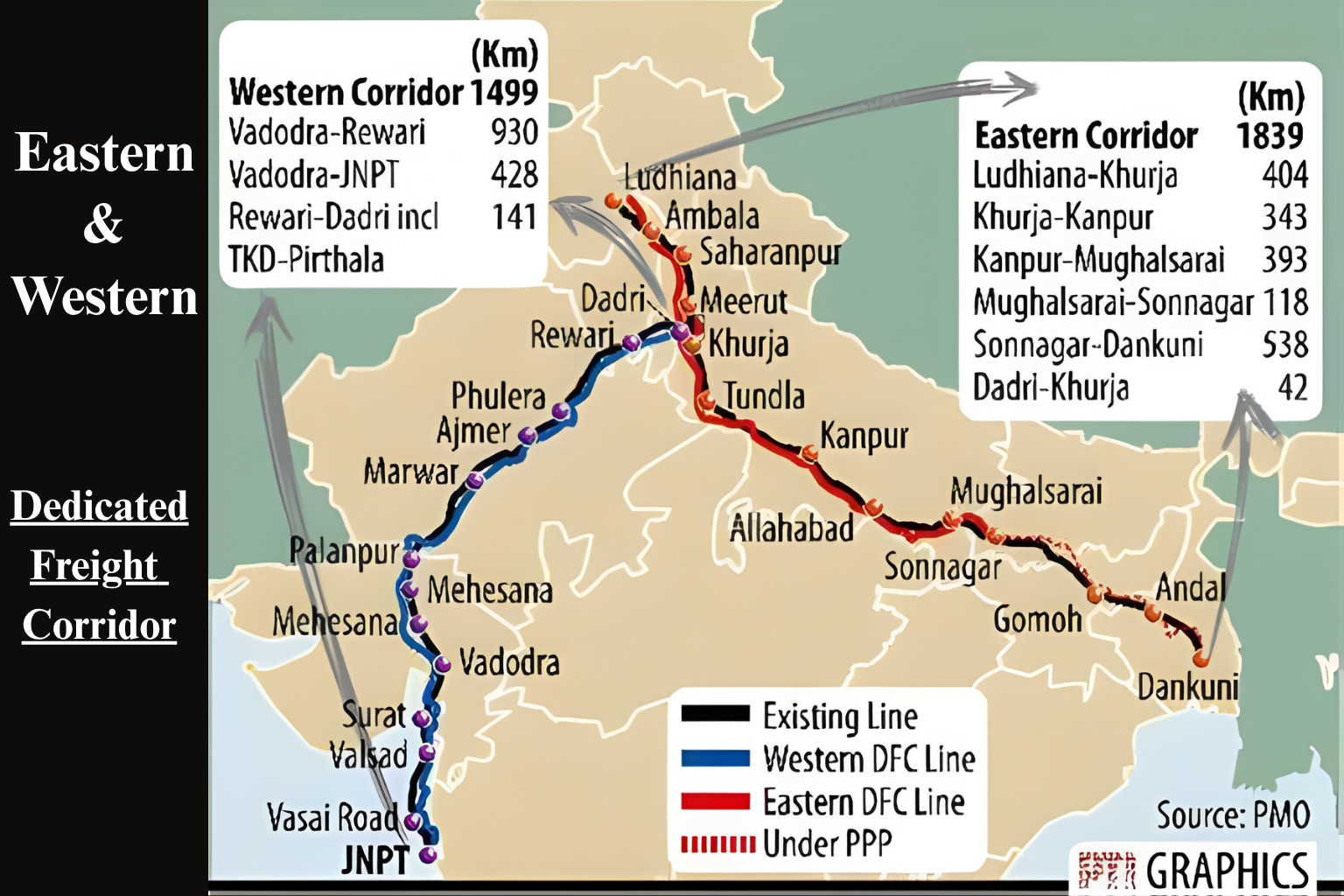
EASTERN DEDICATED FREIGHT CORRIDOR (EDFC)
LENGTH: 1,337 km
ROUTE: Ludhiana (Punjab) – Son Nagar (Bihar)
CORE ROLE: Freight corridor for energy and manufacturing sectors
KEY CONNECTIVITY – LINKS COAL & MINERAL BELTS OF EASTERN INDIA WITH
- Power plants
- Industrial clusters
- Consumption centres in northern India
MAJOR COMMODITIES
- Coal
- Fertilizers
- Food grains
- Cement
- Iron ore
- Steel products
FREIGHT SERVICE TYPES
- Bulk freight services
- Coal logistics services
- Steel & mineral logistics
- End-to-end industrial rake services
- Time-tabled freight services
IMPACT
- Faster raw material movement to industries
- Reliable bulk cargo supply chains
- Improved wagon & locomotive utilisation
- Reduced transit time for power utilities
WESTERN DEDICATED FREIGHT CORRIDOR (WDFC)
LENGTH: 1,506 km
ROUTE: Dadri (Uttar Pradesh) – JNPT (Mumbai)
CORE ROLE: High-capacity container logistics corridor
KEY CONNECTIVITY
Connects northern industrial hubs with major western ports:
- JNPT
- Mundra
- Pipavav
- Kandla
MAJOR CARGO
- Containers
- Automobiles & auto components
- Petroleum products
- FMCG
- Engineering goods
FREIGHT SERVICE TYPES
- Double-stack container service
- Port-connect container service
- Trucks on Train service
- Automobile parts logistics service
INTEGRATION
- Ports
- Logistics parks
- Multimodal terminals
- Gati Shakti Cargo Terminals
IMPACT
- Faster port–hinterland connectivity
- Lower logistics cost for EXIM trade
- Efficient domestic container movement
GATI SHAKTI CARGO TERMINALS – FIRST MILE CONNECTIVITY
To strengthen first- and last-mile connectivity, DFCCIL is enabling development of Gati Shakti Cargo Terminals (GCTs) along the corridors.
KEY BENEFITS OF GCTs:
- Enhance multimodal connectivity
- Reduce cargo handling time
- Decongest existing terminals
- Bring rail freight closer to production & consumption centres
GATI SHAKTI MULTI MODAL CARGO TERMINALS – Are modern, integrated rail-based freight hubs developed under the Ministry of Railways 2021 policy to boost India’s logistic efficiency. By enabling private investment, these terminals connect railways with ports, roads, and airports, using engine on load systems to reduce handling time, cut logistics costs, and shrink carbon emissions.
EOL – Known as engine on load locomotives remain at the terminal during loading / unloading, facilitating faster turnaround time.
ENGINEERING MARVELS & ICONIC STRUCTURES
The Dedicated Freight Corridor network stands out as a landmark in modern railway engineering, delivering complex infrastructure across challenging geographies, dense urban stretches and environmentally sensitive zones. These corridors are engineered for heavy haul freight, high axle loads and long, high frequency trains, demanding a new benchmark in bridge design, tunnelling, alignment geometry and construction methodology.
Iconic structures such as the Sohna Tunnel enable seamless freight movement through difficult terrain and advanced safety systems, while the Kalamboli Girder Bridge on the WDFC showcases precision engineering in a congested suburban environment without disrupting urban mobility. The Yamuna Rail Bridge near Dalelpur, Uttar Pradesh is one of India’s longest rail bridges, carries heavy haul freight traffic across the Yamuna River.
DFCCIL provides a structural solution by creating dedicated, high-capacity corridors that separate freight from passenger traffic, ensuring faster, predictable and reliable movement of goods while releasing capacity on the existing network for passenger services.
NATIONAL IMPACT AND VISION FOR 2047
Beyond logistics efficiency, the Dedicated Freight Corridors have emerged as a powerful enabler of national priorities under the ‘PM Gati Shakti National Master Plan’. The corridors actively support flagship initiatives such Make in India, Start Up India, the Export Promotion Capital Goods Scheme and broader export promotion efforts by providing reliable, cost-effective logistics to manufacturing clusters and MSMEs.
DFCCIL is instrumental in realizing the vision of Aatmanirbhar Bharat by strengthening domestic supply chains, improving export competitiveness and integrating Indian industry with global value chains. As India aspires to become a developed nation by 2047, the DFCCIL stands as one of the foundational infrastructure pillars driving productivity, sustainability and long-term economic transformation.
DAAMRI DEALS PVT LTD ALPHA 1 COMMERCIAL BELT GREATER NOIDA

Recent Posts
DEDICATED FREIGHT CORRIDOR – OVER VIEW
SOBHA RIVANA